


Ancient Combs
Roman Styles
Viking Styles


The top is a comb from the pre-Roman Etruscan period
Below is a comb found on Shetland Island and a comb from the Florence Museum


The Ancient Art of Hair
COLOUR, ALCHEMY and the COURAGEOUSLY CURIOUS

Humanity has always been fascinated by hair its colour, its symbolism, its power to transform identity. Across the ancient world, people experimented with dyes, plants, minerals, and, occasionally, ingredients that would send any modern hairdresser running for the hills. What survives is a tapestry of recipes, rituals, and beliefs that reveal just how inventive (and fearless) our ancestors truly were.
Blondes, Wigs, and the Roman Problem of Respectability
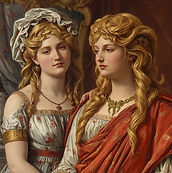
In ancient Greece and Rome, blonde hair carried a complicated reputation.
Over time, it became so strongly associated with prostitution that the Romans
eventually legislated it. Registered prostitutes were required not only to be licensed and taxed, but also to dye their hair blonde or wear blonde wigs so they could be easily identified in public.
The dyes themselves were a creative mix: saffron, coloured powders, and even wood ash blended with vinegar. The playwright Menander (342–290 BCE) warned that respectable women should avoid sitting near “yellow‑haired women,” lest they encourage household chaos and marital disaster.
Yet natural blondes certainly existed. Blonde hair typically results from low levels of eumelanin, the pigment responsible for brown and black hair. Regions with limited sunlight — such as Scandinavia and the Baltic — historically produced higher numbers of natural blondes due to genetic adaptation and reduced Vitamin D exposure. Even ancient Egypt, according to Dr Janet Davey of the Victorian Institute of Forensic Medicine, had naturally fair‑haired individuals.

Egyptian Beauty: Dark Hair, Dangerous Eyes
Despite the occasional natural blonde, the Egyptian beauty ideal favoured dark, glossy hair. Their preferred dye was a potent mixture of lead oxide, lime (calcium hydroxide), and water, kneaded into a paste and left on the scalp for three days. Health and safety regulations were not exactly a priority.
Other recipes were even more adventurous. To darken grey hair, one method involved pickling leeches in vinegar for three months, rubbing the resulting mixture into the hair, and then sitting in the sun for hours. For a rich brown shade, people combined ash, boiled walnut shells, and ground earthworms — an early, if unappetising, form of organic hair care.
The Red Tradition: Henna and Lost Plant
The earliest known recipe for producing red hair dye dates back to around 400 BCE,though it was likely
older. Its source was the henna plant, whose crushed leaves release a natural dye that deepens the
longer it sits on the hair. Remarkably, we still use henna in exactly the same way today — one of the
few ancient beauty practices to survive unchanged.
The ancients also experimented with tints made from juniper berries and two now‑mysterious plants whose identities have been lost to time.

Egypt's Most Curious Concoctions
Egypt, ever the innovator, produced some of the most curious and eyebrow‑raising recipes in the ancient world.
A Hair Restorer (Not for the Faint‑Hearted)
To restore hair, one needed to boil together:
-
the paw of a female greyhound,
-
the stone of a date,
-
and the hoof of an ass.
Apply the mixture and sit in the sun. Not quite the soothing aromatherapy mask we might hope for.

Encouraging Hair Growth
Take one large worm, crush it into a paste, heat it over a fire, boil it, mix it with lard, and rub it into the scalp frequently.
A bold approach to hair care — and certainly a new interpretation of “natural ingredients.”
Preventing Grey Hair: The Masterpiece of Mystery Remedies
The instructions were simple, if stomach‑turning:
-
soak a donkey’s liver in urine (the recipe does not specify whose),
-
leave it in a pot until thoroughly rotten,
-
then mix the decomposed mass with lard and apply often.
Unsurprisingly, there are no recorded volunteers for this treatment — ancient or modern.
A Legacy of Ingenuity and Audacity
These recipes — from saffron‑blonde Roman wigs to henna reds, from worm‑based growth serums to donkey‑liver anti‑greying pastes — remind us that the ancient world was nothing if not inventive.
Their beauty rituals straddle the line between science, superstition, and sheer audacity. And they make our modern haircare routines look wonderfully tame.
Some Techniques and Hairstyles you won't see again!!
Perming 1938
Perming in Libya 70 years later


The Hair Dryer 1948

1928

1938

1948

1958

1968
